

You can tell straight away from the photo above which one is the female. She is telling him off already and we haven't even started. He's apologising not knowing what he's apologising for.
The meerkat (Suricata suricatta) is a small mongoose type creature which lives in colonies. It is characterised by a broad head, large eyes, a pointed snout or nose, long legs, a thin tapering tail, and a brindled coat pattern. If you don't know what brindled mean look it up. I did after I wrote it here.
Like in many colony animals, (e.g. the lion), the male is in charge of the whole colony. In case you don't know what a lion looks like here is a photo of two females hunting to bring food for the male.
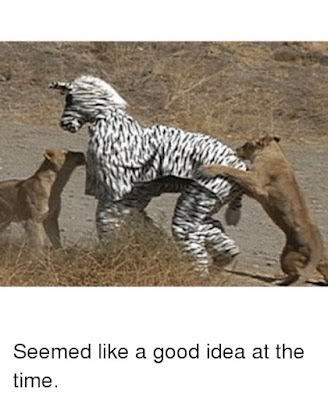
On second look, these don't look much like lions do they? What do you think? The zebra looks authentic enough but the other two creatures are pretending to be lions.
Anyway, as I was saying before you interrupted me; the meerkat lives in a colony and the male is the leader. He fights off other males and the loser leaves the colony. However, at night the females feel sorry for the losing male and they leave the colony and go to sleep with him to keep him company. That is how they refresh the gene pool and keep it healthy. The winning male knows nothing about this because he does not read this Blog.
Meerkats are good teachers. They teach their young for hours on end and increase the difficulty of the lesson to ensure the young have learnt. First they offer their young a dead scorpion and teach him how to fight. When he has mastered that, they give him a live scorpion without the sting and get him to fight it. Eventually they give the young live scorpions and supervise him to ensure he comes to no harm in the fight.
Having said that, meerkats make poor driving instructors. This is because their feet do not reach the pedals of the car. They work in teams with one or two meerkats controlling the pedals whereas another looks from the windscreen where the car is going, and yet one more steers the driving wheel. However, despite their teamwork they still have not managed to drive safely because the females do not know right from left!
(Oh Ho ... there'll be some comments about this).
Let's now move on to insects. The centipede. Did you know that the centipede when it is chased by a predator it detaches one of its legs and throws it at the predator? The predator stops to eat the leg whilst the centipede runs away to safety. Unfortunately, many centipedes die shortly afterwards when they return to retrieve their shoe.
The cricket chirps at night depending on the temperature. If it is very hot it could chirp 30 or 40 times a minute. If it is a little cooler it would chirp perhaps 15 to 20 times a minute. In very cold conditions it does not chirp at all because it is frozen out of its tiny mind.
Also, did you know that silverfish can live for two to eight years unless you hit them hard with your shoe.
And now we turn to birds. The flamingo for instance. Do you know why it stands on one leg? Because if he lifts his leg he would fall.
Storks look like flamingoes only a different colour. In some cultures it is believed that storks deliver babies when they are born.
When I was born the nurse looked at me and slapped my father in the face. For a month afterwards my dad kept throwing stones at storks. They said I was so ugly the doctors tried to get the hospital exorcised. My parents tried to get me exchanged for a washing machine because theirs had just broken down.
As I grew up, like the meerkats, my father tried to teach me to swim. He used to take me out at sea in his boat and lower me in the water. I always got to the shore before the sharks.
That's all for now folks! Keep smiling and the world smiles with you. Oh ... one final thing before I forget ... did you know that when a whale breaks wind it shoots forwards at speed at least ten miles ahead! (Don't try this at home everyone).

